DIN PCR
DIN Product Category Rules (DIN PCR)
This is how PCR are performed at DIN
Product Category Rules (PCR) define, for specific product groups, how environmental impacts are calculated, documented and presented.
PCR therefore form a central methodological basis for the creation of Environmental Product Declarations (EPD).
How reliable environmental statements are depends largely on how the rules are developed. At DIN, this takes place in structured and transparent standardization processes.
How is a DIN PCR developed?
The standardization process for developing a DIN PCR typically takes place in five steps.
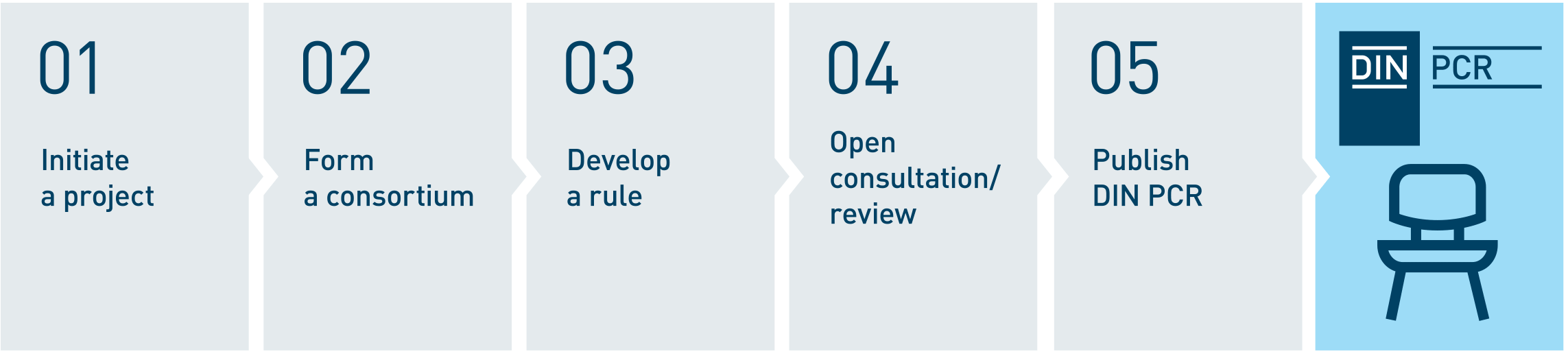
The starting point is a concrete need in practice: companies or industry associations can initiate the development of a DIN PCR, for example if they want to create EPDs for their products.
In the next step, the secretariat of the DIN EPD program checks whether an existing PCR is available that can be used or adapted for the purpose.
If there is no suitable basis for a product category, the actual standardization work begins. A business plan is drawn up and made available for public comment for one month. From all experts – e.g. from industry, academia or environmental protection – who have registered for the kick-off meeting, a consortium is formed and a draft PCR is prepared.
The draft can then be commented on in an open hearing by relevant stakeholders. The feedback, including proposed revisions, is evaluated. At the same time as the open hearing, a review is carried out by an independent panel of experts in accordance with ISO 14025. This is crucial for practical application, because this is where it becomes clear whether a rule is potentially applicable or needs to be refined at key points.
Afterwards, the Product Category Rule is finalized and published as a DIN PCR.
For the structured development of the methodological content, the DIN EPD program uses a template for the creation of a DIN PCR as a working basis, which is available via the online service after free registration.
To ensure a structured approach to developing the methodological content, the DIN EPD program uses a template for creating a DIN PCR as a working basis. |
Ongoing projects
Discover current DIN PCR business plans
You would like to help shape PCR standardization or have questions about how you can get involved?

FAQ on DIN PCR
The PCR consortium is at the heart of the standardization process. This is where different perspectives come together, including:
- Manufacturers who need practical solutions
- Academia and research, which ensure methodological accuracy
- Stakeholders who bring in market requirements
The consortium leadership coordinates the technical collaboration and is responsible for the quality of the draft as well as the systematic evaluation of the feedback from the open hearing.
This close cooperation ensures that newly developed PCR meet technically precise requirements and are at the same time suitable for practical use.
Yes. The standardization process for developing a PCR standard follows the usual standardization processes at DIN, CEN or ISO.
The standardization process at DIN is open and offers various opportunities for participation. Companies, associations and experts can actively contribute:
- by working in a PCR consortium and helping shape a new DIN PCR
- by commenting on drafts as part of the open hearing
Diverse perspectives and the consensus-based approach ensure that Product Category Rules are created that are technically sound and broadly accepted – a key prerequisite for the comparable assessment of sustainability.